I made Jinn Jinn Meets Sadiqi over the CoVid lock-down purely
as a distraction.During the making, I
fell in love with the scratch track by Ravi Shankar because it captured the
playfulness and spirit of what I was trying to do in animation.As it usually happens, I couldn’t get the
rights to use the music in its entirety and had to find free music that fit the
flavor and action but it changed the whole level of energy and mood.It works, and you can see it here:https://vimeo.com/447473057But, I still missed the Shankar tribute version,so I put this version of the Ravi
piece here on my blog just to show how much music can influence the feel of an animated
cartoon.Sorry for the poor quality, (go to the linked version above for better image quality and the alternative sound track), but
this way I won’t get any strikes or violations…
It's the Corona
virus self quarantine here, and I’ve decided to spend my time working on another
‘homegrown’ cartoon from my home studio.I'm expanding on something I wrote about earlier in a posting called Seeing Things that goes over the same discovery process talked about here.
The origin for this film is unique in that it wasn’t
inspired by a book or my attempt to create an original character, it came from a tablecloth! There is a phenomenon called Pareidolia where the brain tries to make sense of chaotic information presented to it.This is how
we see pictures in clouds and faces in patterns.My wife has a tablecloth we use often and in the pattern I saw this extraterrestrial flying in his aircraft, and in another section of the cloth was his alien friend or pet.
I’ve named the ET Jinn Jinn because he might have been confused as a genie because he rides in a Vimana: a Hindu flying chariot. His friend Sadiqi, (which means friend), is also an
inter-dimensional spirit buffalo, or something.
Originally I had envisioned Jinn as a time traveler flying around looking for fun in different historical events and accidentally altering history. He's the one who put the crack in the Liberty Bell and tipped over the Tower Of Pisa. Anyway, I settled on an origin story of how Jinn meets his pal Sadiqi, it gives me an opportunity to figure out who these guys are and what they look like moving.
Like The Yellow
Submarine, this film is becoming a mixture of cultural styles, and turning
psychedelic pretty fast.I know this is not going to be liked by everyone or maybe anyone, but with the quarantine going on; it’s a
nice way to spend some time.
Here are three tests strung together with a scratch audio track added, (it might not play too smoothly).
Jinn Jinn doesn't have pupils yet in these tests which makes him look more evil than he is...
STAY HEALTHY!
Design test with Stand-in Jinn Jinn and Sadiqi
Title Card Idea_01
Title Card Idea_02
Trying to find expressions with this design
More expression exploration
More exploration with a 3/4 head turn and a happy Jinn Jinn
A hungry Sadiqi design
Sadiqi expression test
The original tablecloth that inspired Jinn Jinn
Jinn Jinn against the tablecloth Vimana
Rough version of the Vimana & Jinn Jinn over the original tablecloth
A harder to see Sadiqi, which I modified quite a bit, from the tablecloth.
It's been forever that I have posted to this site, and the last thing was about my personal short animated piece called Philo. It was a cathartic experience that let me recapture the joy of animation and find the things that attracted me to the art form originally.
Since childhood I watched cartoons and was moved emotionally by the imagery and the music. I saw the potential to touch people in a way that live action movies could not. Animation seemed then, and now to be the culmination of all the arts: Cinema, music, dance, painting, writing, etc.
As I was making Philo I tried to pay homage to the studios and individuals who influenced me. I am an admirer of Walt Disney of course, but also the renegades, who broke away from the emulation toward realism, that birthed the stylized look of UPA. Artists like Art Babbitt, Jim Tyer, Chuck Jones, and writer Michael Maltese, along with John and Faith Hubley, Ward Kimball, Bobe Cannon, were and still are reasons why I became an animator. Another early influence for these people as well as myself were the works of the early silent comedians like Charlie Chaplin and the great Buster Keaton.
If you are familiar with any of these, you will immediate see the influence.
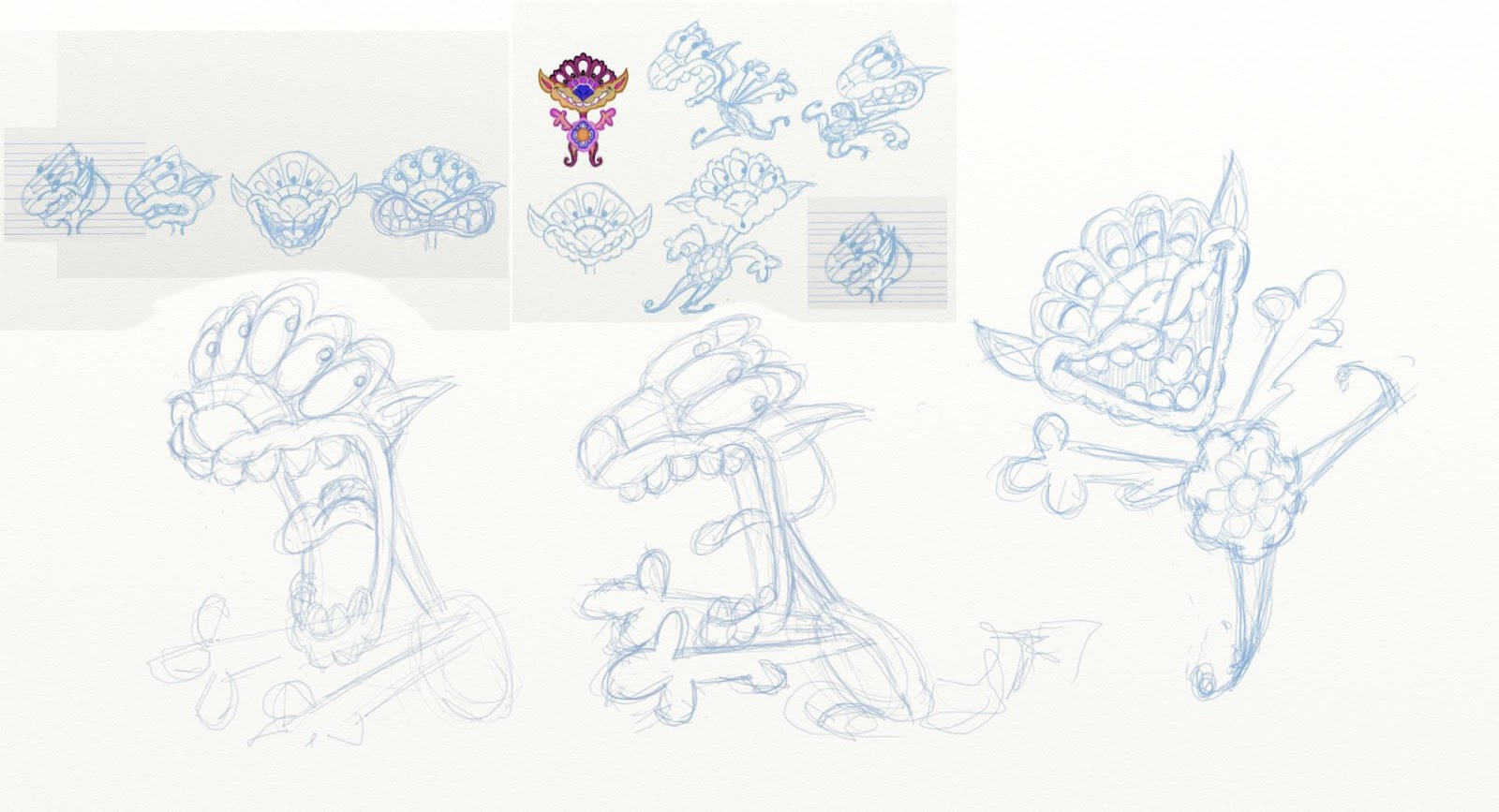
I’ve been working on some pretty stylized character designs for
another personal project.Why I do these
things is not rational and is the same reasons, I suppose, an artist does
anything.But, I’m learning what I’m
doing is heavily influenced by what I enjoyed as a child and the awe I felt
watching animation: moving drawings, imagine that! My films are stylistically different from each
other, each having a graphic look I discovered while growing up in a family of
artists.
I can point to individual artists that imprinted me, and
with this new project I can see this style grew from the work of designer Ed Benedict
who populated Hanna Barbera Studios cartoons from the late 50’s.
The backgrounds are influenced by the rebellion, that sprang against
Disney’s realistic literalness, that began with the UPA studio and their embracing
of modern art. The high styling of both characters and backgrounds was so popular
that even Disney had to incorporate it to appear fresh and relevant.
The animation style I’m trying to work in comes from the Disney
artist Art Babbitt who was able to mesh the fluid motion of classical drawn
animation with the high stylized designs that was happening at the time.Unlike the limited animation that Ed Benedict's designs were subjected to at Hanna Barbera, Babbitt frequently animated
on ones, meaning 24 drawings for every 24th of a second film required,
instead of the 12 drawings shot twice which is a common practice, ( it is still recommended
that ones be used on very fast actions).A great example of Babbitt’s integration of
fluid classic animation and high styled characters would be his work in Richard
William’s The Thief and the Cobbler.
This new project may take some time to finish because I don't have any
help on it,but I am having fun drawing just as crazy as I want. Animation has become play again instead of work.
Below is a clip setting up the conflict between characters. It's nothing too original but I hope it gets the story going.
Animation clip with scratch track and no sound effects.
The trouble with doing a personal film is they can take
forever to do.Real work and real life
have a way of eating time and energy from projects that you may want to do,
and this short film is one I never thought would be stretched out over years.The short was fraught with troubles which
made it easier to shelf and neglect.But
technology progressed and I was able to solve some of the problems I couldn’t
when I first started.One I’ve never
quite fixed is the narration which was completely unusable.I tried rerecording many times and never
could match the inflections and feel of the first tracks.After filtering the heck out of them, this is
the end result.
I’ve always loved Wilhelm Busch and his quirky style.He reminds me of Edward Gorey to some degree
but Busch pioneered some visual jokes which have become cliché standards in cartoons
from the golden age of animation.I
wrote about them in this earlier post: http://joelbrinkerhoff.blogspot.com/2006/08/cartoon-inspiration.html
Here is my faithful adaptation of Wilhelm Busch’s Ice-Peter.
It's been awhile since I've posted anything which means I've been busy, but here's an update on my search for ergonomic working in the digital age.
I ran across a workstation that is very similar to mine using the same software, Cintiq and monitor configuration. The big difference is that I don't have to reach over my drawing to get to my keyboard and that surprisingly makes a real difference.
CLICK ON IMAGE TO ENLARGE
You can see my system, on the left with the yellow sub on the monitor,
can dock menus on the large monitor and leave the Cintiq free for
drawing. My Cintiq is elevated and at a comfortable height and angle
for drawing and my keyboard is mounted underneath which is ergonomically
better and keeps me from stretching over my drawing to get to.
I did this awhile ago but my work-space has been ergonomically improved
by Velcroing the keyboard onto my riser holding the mini-Cintiq. No
more weird twisting. Here's a side by side picture for comparison.
I’m not ashamed to say I’ve been around awhile, and I’m
proud to say I’ve worked in animation professionally for most of that
time.I share a time period similar
with legendary animator Eric Goldberg who has repeatedly said his influences
were early television which used the best of theatrical shorts to fill it’s
ravenous maw with screen time.Every
Hollywood studio had a shorts division, and specifically an animation studio,
turning out on average, 12 seven-minute animated cartoons a year.These cartoons were made by adults and aimed
at a general audience who might find them equally as funny as the people who
made them.
Television gave these old shorts a new audience, (they even
played the silent cartoons with piano music added), and created a special arena
for new cartoons made especially for this media.Hanna Barbera, who incidentally gave us the wonderful, noisy, and
hilarious original “Tom and Jerry” cartoons, made a reputation with their
limited animation series and dominated the Saturday morning time slots, and
even broke into prime time, with original material.
I was able to watch and learn from it all.Now, I’ve been given a chance to do some
limited animation myself.The term once
was a derogatory slur and called ‘Illustrated Radio’, because of it’s reliance
on heavily dialogue driven scripts. Admittedly the over use of dialogue is
still a problem with today’s animation, but I digress.
One technique, used to fill copious screen time with the
least amount of animation, is the wide establishing scene, or a master shot.From this wide perspective all the
characters are shown, and then cuts to individual characters in close-up or
isolated groups are used to bring focus to who ever is speaking and should be
the center of our attention.Cutting
around this main group of people can bring life to a static stage setting and
the reuse of mouth shapes and simple gestures used to fill minutes of screen
time.
I used this "master shot' method to pitch an idea for my New Bremen Town Musicians, or BTM to a studio I was working for at the time who wanted to look into web-animation. Made in Flash before it was thought of as an animation platform, I did two master shots and cut around inside them. Remember this was done for a pitch session in-house and never meant to be seen by the public so the sound is awful but I wanted to show it could be done quickly.
I used the same technique for my talented friend, Jim Hardison.Jim is the creator and writer for “The Helm”, a popular comic
book published by Dark Horse.Jim
wanted to keep cost down, and we agreed on a kind of “Scooby Doo”
approach.This is what I came up with
for him, ‘limited
animation’, using one long panning background; the same recycled animation
and a few camera cuts.
It was quite fun and a second one is waiting to have music
scored for it.I hope you enjoy it and
you really should check out the comic book, which has some great artwork and
very clever writing.
Mary isn't the only one who is contrary. I was made fun of for my work station in my home office. You see, I have a habit of using my right hand to draw and my left on a computer mouse. Now, that's not to say I don't use my right hand for the mouse...I just switch it up a bit. Hopefully I won't get carpal tunnel syndrome, or the worst would be I get it in both hands. Anyway, it works for me.
Most people who do graphics work on the computer use a large 21" Cinque, and, if you read my blog with any faithfulness, you know my struggle to get something comparable, yet more inexpensive. I made a decision on a 13" HD, and am well pleased. It fits my space and I can dump all my menus and tools onto a preexisting monitor where they are larger and more visible than if they encroaching on my work-stage.
You can see I share one mouse pad between two systems, and that works well for me too. Go figure...
UPDATE: I found having the keyboard to the side a big inconvenience, and caused me to twist uncomfortably. But, by adding some Velcro to the back of my keyboard and the riser the monitor sits on, I can mount the keyboard comfortably in front of me. I also added mouse pad so I'm not sharing anymore.
It's rare that I get to do much emoting in commercial work so I've been playing with some acting exercises just for fun.
What I find interesting is how the same character can have a different personality depending on the voice and the dialog.
The
first voice I chose is actress Piper Laurie, and the feeling I get from
her is a middle aged woman who has had it with a disrespectful younger
lover, (this is all fabrication on my part because I've never seen the
movies). I don't know who the next British actress is but she sounds
much younger, like a teen, or early twenties, and is either proud of or
embarrassed by having been caught in a lie. The last is the late great
Phyllis Diller, who always brings a wacky flare to all her work. I
think of this test as a princess possessed by a crazy witch. She looks
very cute but her actions give her away.
Fellow blogger, and animation artist, Eddie Fitzgerald has
recently posted on his inspirational “Uncle Eddie’s Theory Corner”, an article about artists work spaces, (link provided here:
http://uncleeddiestheorycorner.blogspot.com/), which I liked very much and
responded to.He offered an invitation
for me to show my space if I cared to, so here it goes.
As I mentioned my wife hates clutter because her mother was
a messy artist, and she had to clean the house around her moms work area, which
also spilled over into their living space.Well, my mother was a messy artist as well, and we lived in what she
called 'creative clutter', which I loved!
Wanting to keep a happy wife and an inspirational
environment, we have managed a pretty good compromise.I can’t show you our entire house, which is
an eclectic mix of styles and cultures, but I can show my work spaces and touch
on a little of how I work and what inspires me.
My office is pretty digitally oriented for computer animation and this over-view
picture kind of shows the contained chaos.I have my messy bookshelf, walls of pictures, musical instruments and my
sculptures and toys.Some of the
details are an unfinished portrait of my daughter begun by my late mother,
which hangs above my desk, and a picture of my brother in period clothing that
mom did, on another wall.I also have
paintings my mother-in-law did, and our mothers’ works are hung through out our
house.
Downstairs I have a man cave with all my toys put in a wet
bar, and movie posters on the walls.This leads to my other work desk reserved for messy things like
sculpture, or painting.We have a
cement floor in this part as it is also the laundry room, so I can drops
brushes or cast plaster molds if I want.
There it is.I’m very thankful for what I have.Hope you all have a great Thanksgiving!
Daughter by my mother
Brother in period costume by my mother
Wind chime (hung inside)
Another wall hanging
Shelve in office, (note the Vinton box for floppy disks!)
Rug hung on wall
Wall hanging
Book case with sculptures I've done
Wet bar with collectable toys (sorry about the glare)
Basement desk for messy work, (portrait of grand-kids on easel started for Christmas, don't tell!)
If you have read this blog for anytime you know of my desire for a Cintiq but the price even for a used one is too much to justify. I had hoped they would become more affordable as time went by but not so. Well, now the universe is conspiring to make it a feasibility to draw digitally with the quality and interface I would like. A relatively new, at least to me, South African company has the Bosto Kingtee which looks very attractive and inexpensive. I've got my eye on the 22HD. I'll let you know what I decide.
In the meantime check out these vids and their site: http://www.bosto.co/products
Update: I just heard from Toon Boom that they have never tested Harmony on these tablets because they use only Wacom technologly. This could be a big problem if the driver don't work right.!
Update: I just heard from Bosto Kingtee and the 22HD has been updated with new drivers and chipset! Oh boy!
Here's a collection of 2D bits and pieces I've done. It shows Flash scenes from "The Mr. Men Show" and traditionally drawn scene from my short films, plus Harmony scenes from "Hoop & Yoyo" using vector art.
With my exploration of using Toon Boom Harmony and Animate, or After Effects to get a workable 3D into my next film, I thought it would be good to show how intricate and involved the pioneers at Disney were when they created the Mulitplane Camera
Of course Unca Walt explained it best in this segment from The Wonderful World of Color, and concludes with the breath taking shot from "Bambi".
Today we do everything digital, but think about the challenge they faced then trying to keep lights from reflecting, and dust or finger prints off the art, and the mathematics used to plot out moving these big fragile plates of glass!
I own a version of Toon Boom Animate and have worked with TB Harmony. Both have 3D multiplane features. TB Animate has planes that you can separate into layers but Harmony has planes you can rotate and lay flat if you wanted. You could build a little 3D house and move around it, which is what I want to do. Well, I own TB Animate and an upgrade to Harmony is too rich for my budget right now.
So I was a surprise to learn After Effects has this 3D function. I've been learning to animate in this program and it's pretty straight forward. You can do some nice hinged puppets by adjusting the pivots and parenting flat artwork together. There is a way of doing the equivalent of scrubbing through a nested symbol like in Flash or Toon Boom to do lip sync. This is done through importing image sequences, and you can use it to do a more traditional style drawn animation, but I'm finding it's very hard to edit, but it does have this 3D function like Harmony that I've mentioned.
I thought this would allow me to get the 3d effects I want and save me the cost of upgrading to Harmony but I must be doing something wrong. I took some artwork from a past personal project and a future piece I'm working on and set them up in 3D using After Effects. Even in the program as I scrolled through the animation I got planes dropping out or jumping levels. I thought it might be a graphics card thing but even rendered the planes popped in and out. If anyone knows a fix for this I would love to know. It may be a format setting or something because the look is totally different from a rendered TB scene.
First test in After Effects with dropped layers.
Sec test using After Effects with dropped layers.
Test using Toon Boom Animate with AE floor
I think I have a work around by rendering my 3D elements, in the black and white scenes, it's the wood floor moving in perspective, using After Effects and bringing the sequence into TB Animate where the other elements are separated into planes that use depth only.
Update: I did get the scene to work in After Effects without layers dropping out. I had to insure there were not intersections where one layer momentarily penetrated another.




 Animation clip with scratch track and no sound effects.


