Thursday, September 03, 2009

Maria Gurevich

Animator/Puppeteer Zack Buchman and Producer/Doll-maker Maria Gurevich have teamed up to create Furry Puppet Studio and you can learn more about them here: http://www.furrypuppet.com/

I've posted some of Maria's delightful dolls to show how charming they are. A little Marc Chagall, kind of Heinz Edelmann, these designs would be beautiful animated.

See more of Maria's work by clicking her name in the title of this post.


Saturday, August 15, 2009

3D Shower


A continuation on my free view style stereoscopic paintings. Click on the image to enlarge then cross your eyes and focus on the image formed in the middle to view in 3D.

Sunday, August 02, 2009

First Animated Christmas Special Book


I just got my copy of animation director Darrell Van Citters' book, "Mister Magoo's Christmas Carol: The Making of the First Animated Christmas Special", and it's terrific.

I knew Darrell from working on the first season of Cartoon Networks "The Mr. Men Show", and when I heard he shared a love for and was writing a book on the Magoo Christmas special, I was thrilled because now I might find out more about one of my favorite cartoons.

Magoo's Christmas Carol was something I tried never to miss. Not only is it a faithful retelling of the Dickens' story, it's also true to the character of Mr. Magoo. There are beautiful songs and moments of comedy and heart touching poignancy.

Let me tell you this is a great book full of beautiful production art and well researched information on who and how this classic show was made. After just reading the introduction I learned Walt Disney was so deeply moved by the show after its first airing that he made a personal call to the producer to congratulate him. It's chuck full of stuff like that!

Click the title above and go to Darrell's website where you can learn more about this wonderful Christmas Special and order a copy of this well written and glorious book.

Thursday, July 23, 2009

Bath Time in Pepperland

Click image to enlarge

Heinz Edelmann, who developed the psychedelic look of the Beatles’ animated 1960s film Yellow Submarine, died on Tuesday, aged 75.

I didn't intend this as a tribute to him but this 3D free view painting of mine clearly shows his influence.

To free view this image you must cross your eyes and focus on the image formed in the middle.

Tuesday, July 21, 2009

Fourteen Indians

Occasionally I've mentioned my mother and her influence on my paintings. Recently she had me scan some of her Indian paintings. The originals had been sold and all she had were pretty bad photos. Even so the handling of her brush strokes and the expression in the faces re impressed me as to how good she was in her prime.

Mom has rheumatoid arthritis and is battling the slow loss of her hands. I'm grateful to have a few of her many paintings saved digitally and glad the originals are hanging in someones homes.

The Indians were only a favorite subject for my mother and her paintings ranged from portraiture to landscapes, fantasy to still-life. She worked not only in oils but did water-colors, pastels, charcoals, and sculptures too.

It would be fantastic to get a collection of her work together but I have no idea who owns what. Maybe mom has an address book of past clients.


CLICK ON IMAGES TO ENLARGE

Saturday, July 18, 2009

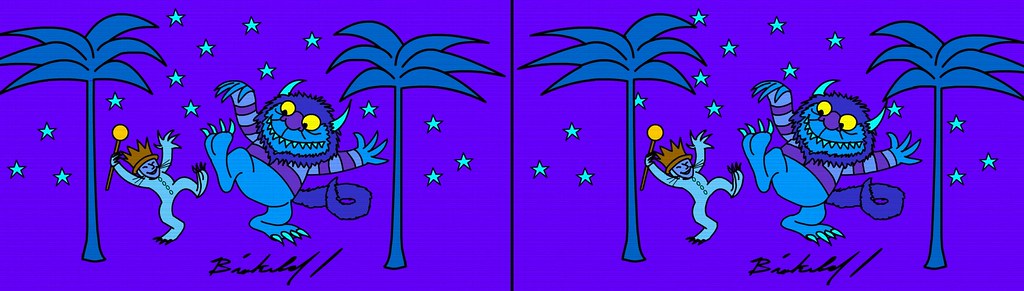
3D Rumpus

It wasn't used because apparently you need to be invited but here's my free view stereoscopic offering to Terrible Yellow Eyes, Cory Godbey's blog that celebrates Maurice Sendak's "Where the Wild Things Are" Click the title to check out more artwork by various artists.

Clicking the picture will take you to my Flickr page where the double image lives. There you will be able to free view in 3D.

If you are unfamiliar with 3D free viewing, you must cross your eyes and focus on the image that forms in the middle. It's a great headache inducer!

3D-Rumpus

Wednesday, July 15, 2009

Walt's Vision...

Click image to enlarge

http://www.michaelspornanimation.com/splog/?p=1917

This is one page of an eight page letter from Walt Disney to Don Graham about Disney's idea of night classes for his animators.

Clicking the title or pasting the link above will take you to Michael Sporn's posting of the entire letter and a little history on how these classes later evolved into Cal Arts.

What leaps out to me is Walt's understanding of the needs to be communicated in animation and how best to teach these ideas. He shows an understanding of how motion is influenced not only by physicality but also motivated by emotion.

Walt doesn't shoot out some ambiguous letter full of generalities on improving the product and building moral. This letter is a well thought out strategy suggesting the needs and how to meet the needs to push his studio beyond what everyone else thought animation could be.

The success of Disney animation clearly came from Walt's willingness to equip his artists with a full training in draftsmanship and motion analysis and his practical suggestions on how to go about achieving that.

Monday, July 13, 2009

Enchanted Dolls


Doll maker Marina Bychkova has a site displaying her beautiful articulated porcelain dolls. They are intricately fashioned with graceful hands and expressive faces and are anatomically correct.

Bychkova has a real design sense and some of the figures wear elegant tattoos and exotic head ware.

These beauties are extremely pose-able and a section of the site has demos of their versatility and ability to hold a pose. The figures immediately suggested stop motion puppets to me and would probably lend themselves very well to it.

I believe these lithe ladies would be great aids for artists and more useful than those ugly wooden manikins.

Click on the title or paste this link to see more: http://www.enchanteddoll.com/galleries/costumed.html

Wednesday, July 08, 2009

Style vs Style

I ran across the cool promotional video for Kevin Dart's art book,“Seductive Espionage: The World of Yuki 7,” on Cartoon Brew.

Although the design is lovely I feel it suffers from the curse digital animation seems to promote and that is a tendency toward robotic hinged movement. It's understandable because the method is to literally cut the artwork up into pieces and assemble it like paper cut-outs. The limbs rotate from fixed pivot points and everything is flat flat flat.

The argument is an aesthetic one where the artist has deliberately chosen that look. This may be true, it certainly is becoming wide spread.

I love high styled designs in animation but I think I would have done some hand drawn animation on top for hair and clothing to ease some of the stiffness.

Stylistically the design could have been the same and treated in a more graceful way emulating traditional drawn animation. Take a look at one example of high styled limited animation from the opening of "I Dream of Jeanie" and try and imagine the World of Yuki trailer retaining the graphic style but moving like that.

Now before you get all upset let me clarify that I understand this trailer was done on a very short schedule and I think they did a brilliant job but I would love to see the same graphic style in a more lush manner.

"A Kiss From Tokyo" Theatrical trailer from Stephane coedel on Vimeo.


Tuesday, June 23, 2009

Oxberry Camera


http://www.michaelspornanimation.com/splog/?p=1652

Clicking the title or pasting the link above will take you to an article posted by Michael Sporn about John Oxberry, the maker of animation cameras.

It brought back fond memories of my first job in animation. It was at a commercial house in Ft. Wayne Indiana that used an Oxberry with aerial image projection for rotoscoping, effects and combining live-action with animation.

I recall the hum of the motors that ran the camera up and down it's double rostrums was loud enough to drown all ambient sounds from the room. This was a good thing and helped focus your attention on the mound of artwork, the correct camera settings and following the exposure sheets.

The N/S, E/W pegs were all hand cranked, (there may have been servo motors too that you could program), and the exposure sheets had all the computations for every frame marked out in the camera column.

Fortunately for me it was not my job, although I did shoot some less complex scenes on it, because it involved consulting big expensive books full of mathematical equations to figure compound moves with fairings to ease in and out.

Our brainy cameraman Chris Dusendschön later went to Robert Abel Associates and got involved with effects and early computer graphics.

My second experience with Oxberry was at Will Vinton's Claymation Studios. There was a derelict camera that sat dejected for years until another brainiac Animator/Director Hal Hickle restored it single handed. It was used for titles and Animator/Director Mike Wellins did a short film using paper cutouts on it.

Incidentally Hal also owned one the the cameras Ray Harryhausen used to shoot "Mighty Joe Young".

I am excited by the digital revolution and the autonomy it allows. But I'm also glad to have experienced the early method of cartoon making and kind of miss the big toys.

Click image to enlarge

Wednesday, June 17, 2009

Disney Picture

I haven't read this book but I love the cover. It's great that Walt was photographed from the same angle and posture. I love the intensity of his early picture and the contrast of the later well groomed Walt.

Click image to enlarge

Saturday, June 06, 2009

Something Strange and Provocative...

I found a great blog about Illustrators called Today's Inspiration that you can find here: http://todaysinspiration.blogspot.com/

There is an article about my favorites, the incredible husband and wife team, Alice and Martin Provensen.

I was surprised to learn they designed Tony the Tiger and the other Kellogg cereal mascots in 1953.

Click on the title or go here to read more: http://todaysinspiration.blogspot.com/2008/07/provensens-something-strange-and.html


Friday, June 05, 2009

It's all in the Scrawl

click image to enlarge


I’ve been enjoying the first volume of Walt Stanchfield notes from Disney drawing classes, “Drawn to Life”. It’s a wealth of information that must be taken in doses.

Like animation itself the book is intimidating in the amount of details that must be judged and juggled, but there is also a source of comfort for me. The book is filled with scrawl. I know scrawl is a term for poor penmanship but I'm using it to describe loose scribbley tangled drawings.

We are all familiar with the beautiful draftsmanship and elegance of a finished Disney still. What we haven’t been privy to are the rough developmental drawings that evolved into these beauties.

The examples I’m posting are actually more legible than most but show the loose building up of masses and how they relate to each other traveling through 3D space.

Being able to see the masters’ messy exploratory scrawl is always liberating for me and I feel less inclined on trying to make a ‘pretty’ picture and more empowered to do something with vitality and power.

Monday, June 01, 2009

Getting Goofy with Toon Boom...

I started playing with the Toon Boom Animate Preferences settings and found I could get a fair digital 'pencil' that would act more like a real one. I also decreased the opacity on the pencil color so now I can sketch lightly and build up a line without it becoming too dense.

Here's a walk I tried using a model sheet of Goofy I found online.
I had read somewhere that Goofy was kind of a circus clown so I wanted to try and make a goofy clown walk for him.

I didn't bother cleaning and finishing this because I'm lazy, (there's some stutters here and there I need to take out too), but I think I'm getting a technique worked out.

There have been some unexpected crashes too and I don't know if it's a Vista compatibility issue or what. Sometime it's pretty smooth going and I get lulled into a false sense of security.

I'm still using a Wacom tablet but if I angle it a bit it's more accurate.


_____________

Perhaps this part should be called Goofy in the Sky with Diamonds...

I took my ruff animation and just colored it to see what it might look like with solid fills. I stuck a background behind it but it wasn't long enough to pan so I stretched it.

Even though it's a little trippy I'm encouraged that I could do old school type animation with this.

Saturday, May 30, 2009

Adult Characters and Advertising

UPA created Mr. Magoo and Hanna Barbera made The Flintstones with an adult audience in mind. The Flintstones was the first prime-time animated series and was sponsored by Winston cigarettes.

These delightful commercials would never fly in today's PC world but they show how fun advertising was when the corporate executives, (before the agency 'creatives' took over), trusted the studios to make something for them without interference.


Wednesday, May 27, 2009

Something in My Eye...


The advance word on Pixars latest film “Up” is that they have done it again with a wonderfully entertaining and poignant story.

Did you catch the word ‘poignant’? Yes it’s something many animated films forgot to work into the mix. A good story in general has to connect with situations and characters we the audience care about and can relate to.

How many animated films can you remember that have sacrificed pathos and sensitivity for false bravados and ultra cool characters that laugh in the face of danger?

In an attempt to be current many animated films gave us shallow heroes with little compassion or insight who blather innate verbal banter in an attempt at wit. They crack jokes at inappropriate moments such as confronting death and dodge hazards as if they were on an amusement park attraction.

These films failed because they didn't connect emotionally with the audience. If the lead characters were unaffected by their situations why should we care?

The best animated films let us feel with the main characters. We understand them and have had similar experiences. We see a part of ourselves in them and worry when they are in trouble and cry with them when they are sad.

The best animated films always seem to have that ‘lump in the throat’ moment where you hope no one notices if you shed a tear.

I’m banking on “Up” giving us an emotional connection with these characters that will linger with us long after we leave the theater.

Friday, May 15, 2009

Squirrelly Squirrels

I had the pleasure of teaming up again with my friend and fellow animator Melik Malkasian to animate these crazy squirrels.

Melik is a fine actor and has appeared in several TV shows, stage productions, and feature films so it's always a great experience working with him.

This is the second time we've teamed up to animate these squirrels. They've been modified but we first animated them in the direct to DVD movie "Dog Gone".

We tried to divide the shots up equally by length but somehow Melik got to do the great dancing scene. I fortunately did get to do the scenes where Leroy squirrel gets hit on the head and drops all his nuts. We tag teamed on the high-five and the running around the tree shot,(only shown on the website version).

This video is without sound but you might catch a better quality version of it on TV or better yet go to this website, watch the video with sound, roll over the squirrels to make them talk, look for Bigfoot and play some games while you're there.

http://www.firsttechfans.com/

Paste address above or click on title to go to site.

Tuesday, May 12, 2009

Flipping out in Toon Boom

Because I work primarily in 3D animation the time for exploring digitally drawn traditional animation has been on and off. I am getting familiarizes with the Toon Boom interface and tools but one big obstacle I'm hoping someone has overcome is how to 'flip' or 'roll' the drawings as one would using paper.

I thought being freed from the mountainous stack of loose drawings would be a big advantage. And it is to some extent but there are times when I want just a few drawings and to be able to put them in any order I want.

Many is the time I will reverse the order of the Key drawings when I'm doing the inbetweens, rolling the drawings back and forth to see the action. I can't do that digitally. Now you can use what is called 'onion skinning' to look through your stack of drawings and you can scroll back and forth in a time-line to see the progression of the action but it's not as discrete as having those pages on pegs to roll between your fingers.

With paper I can find those tweaks a drawing needs as I'm rolling the pages back and forth and can make changes and additions on the fly. But digitally I need to be on the right image layer and have it active to access a drawing. I've drawn on the wrong image sometimes impulsively because I wanted to make that addition and forgot I had to break my concentration in order to pick the right drawing level.

There must be something I am unaware of because many big studios are using Toon Boom today and I'm sure these issues have been addressed by them.

_______

My friend Eric told me the keys F and G toggle between drawings and that seems to work to an extent. I can do better just scrubbing through the time-line.

Monday, May 11, 2009

Sita Sings the Blues on YouTube

Here is the gorgeous film "Sita Sings the Blues" by Nina Paley in it's entirety.

The movie is available for FREE download in 1080p, 720p, and 480p!
For an updated list of download or torrent links, go to: http://sitasingstheblues.com/wiki/ind...

Sita Sings the Blues, by Nina Paley
http://www.sitasingstheblues.com

DVD version(s) will be coming soon!


Please help support this film.

Monday, April 20, 2009

Going to the Dogs

click on image to enlarge


I've been reading the Walt Stanchfield books "Drawn to Life" and feeling guilty about not drawing every day. These guys were handy so I did some fast sketches.

Saturday, April 18, 2009

Disney Reuse Cont.


Following the delightful video of the Disney's reused actions in the last posting, I found the scenes I personally remember being recycled.

Now I know this was done partly for economic reasons but it can't have saved that much considering the action had to be redrawn to different character designs. But the timing was there and the action proved entertaining so I guess it did save time in concept and direction. Need a dance sequence here? Go to the vaults!

Friday, April 17, 2009

Disney does Disney


My friend and talented animator Jim Richardson sent me this awesome compilation of recycled Disney animation.

I remember as a kid seeing the same elephant actions from Jungle Book used elsewhere and the same actions used for Mogley, (Jungle Book), Christopher Robin, (Winnie the Pooh), and Wart, (Sword in the Stone), but I didn't know it went soooo far!

Monday, April 13, 2009

First Assistants and Clean-up: the Unsung Heroes of Animation


“My assistant will take the scenes over and really add quite a bit to the stuff. That is part of the function of the first assistant. Several pieces of animation in this reel are examples of the value of the first assistants and the cleanup men. There are several scenes in this sequence that I know would never have resulted as they did if the cleanup men has not been able to draw and did not know something about animation.”: Bill Tytla

The above quote is from legendary animator Bill Tytla during an action analysis class. Here is one page of that talk where the quote can be found.. The whole talk can be found here: http://afilmla.blogspot.com/2009/03/tytla-speaks-on-forms-vs-forces-i.html

What I found interesting is the complete honesty about his process of animating and how it's not any one thing in particular but a blend of many elements.

One thing the studio system had going for it was the distribution of labor which allowed the lead animator to concentrate on the big acting gestures and handing off the scenes to assistants who polished and filled in the additional drawings bringing the action up to the 24 drawings per second of screen time. The scenes were cleaned up during this process and details added such as fingers, buttons and hair etc. by more assistants known as clean-up.

These guys had to be good or they could blow the whole shot and ruin the animation altogether. We all hear about the Lead Animators but it's a shame we don't know much about their assistants.

Thursday, March 19, 2009

ToonBoom-Bastic!


http://toonboombastic.blogspot.com/

Following quickly on the heels of my traditionally drawn test using Toon Boom I thought I would mention this site a fellow Boomer turned me onto which the above link, or clicking on the title will take you to called TOONBOOM-BASTIC!

These people are using Toon Boom for an actual production and using the nested symbol approach associated with Flash animation. This is a great reference site because they define the similarity and differences between the two programs.

A great posting was the way nested symbols work in both Flash and Toon Boom and how they behave differently. The image is from a posting about Layer organization and was super enlightening.

I'm about ready to try some puppet style animation and this site already answered many questions. Check it out.

Wednesday, March 18, 2009

Don't Tell Olive...


This is yet another Toon Boom test drawn with a Wacom tablet. There are many things that can ruin animation and they are all in this test: bad animation, bad in-betweens and bad clean-up.

I'm hoping I can get better hand and eye coordination but the Wacom is still a disconnect and I really may have to save for a Cintiq if I'm going to do this seriously. Also I find it much slower going than pencil and paper. I tried setting the opacity low on my brush so I could build up a stroke like a pencil but it soon became pretty dense anyway. Here's also a test of a mouse walking I did trying to learn how to draw Jerry, (looks nothing like him!), that was done with TVPaint and the pencil tools are terrific. Hopefully you can see what I'm talking about.


Even though the test was disappointing I did learn how to separate a background element so Betty could pass behind the railing. Popeye's transition from a walk cycle to stand is awkward but I know the mechanics of how it should work now. And I also learned I need to be more careful with proportions and tracking things like breasts. You would think I would have more interest there wouldn't you?

I may have to play with these characters again because this is the first time I've tried to draw them. Betty's head turn is awful. She's pretty hard to draw and those curls are murder to track too.

Friday, March 06, 2009

Drawn to Life


We live in wondrous times. For years I have seen bits and pieces of these notes that were the handouts from Walt Stanchfields drawing class at Disney and marveled at their clarity. Now two volumes of Stanchfield notes and art stretching over twenty years have been assembled and will be available this April.


A good overview can be found from a former student on The Animation Podcast here: http://animationpodcast.com/archives/2009/02/27/walt-stanchfield-books/

The following is just a portion of the review...

Walt had the most joyful, energetic spirit I have ever known. Yes, his classes were about drawing, but they were also about seeing, judging, storytelling, passion, life, creation, sports, clarity, art. “Live life dammit!” is something he would say. He’d tell us to ignore all that garbage we learned in anatomy class. He wanted us to make decisions in the drawings and tell a story through the image. If we drew the model exactly, he’d show us how more interesting it would be if we pushed the pose, moved the hand out here for clarity, tilt the chin to direct the viewer’s eye to where we want them to focus. He didn’t want us to draw what we saw, he wanted us to take in the idea and power it on to the page with verve and directness. He was so hooked on creativity. He’d sometimes share his latest drawings that he made while driving down the freeway from his home near Solvang!

__________

I did a post of this page of Walts Tiger notes before but it warrants a second look.

Click on image to enlarge.

Wednesday, March 04, 2009

Jerry and the Four Foot Mouse

Okay Toon Boom had a great offer of $600 off the asking price for their Animate program so I took the plunge. I'm wading in slowly as this program does a lot of puppet vector based animation like Flash but what I've been interested in is a good paperless way of doing traditional drawn animation.

Here's my attempt at another Jerry Mouse. I just like his design and want to learn how to draw and pose him. The more I try the more I see his face is very similar to Toms and may try Tom next. The 'holds' are a little long and I should add another blink on the other side to keep it alive. Maybe some 'eases' too.

This was all done in Toon Boom Animate and I'm learning how the drawing tools work. I am using a Wacom table because I can't afford a Cintiq so clean up is still difficult. All in all, I like the program very much and look forward to learning all the bells and whistles.

For all you animation Nerds, (of which I am one), you may recognize the background as being the stage from The Mickey Mouse Club. That's why Jerry is scared and you would be too if a four foot mouse was coming to beat the crap out of you! My money would be on Jerry to win.

Sunday, March 01, 2009

Symbolism in Animation

It has long been a complaint that we are relying on dialogue too much instead of good acting in modern animation. Since animation is a visual medium it makes sense to try and make everything understandable even if you strip the soundtrack off.

The use of symbolism is probably a carry-over from the days of silent cinema where everything had to be communicated visually but it does have the advantage of super-charging a scene by loading it with layers of information.

Certain types of film lend themselves better for the use of symbolic imagery such as the Musical and the Fairytale because they are already stylized and more fanciful in the storytelling right from the beginning.

Symbolism in animation began with animation itself and one of the best examples is Disney’s “Snow White and the Seven Dwarfs.” The queens casting of spells to make a disguise and poisoned apple use symbolism to load the imagery in a powerful way that go beyond dialogue with a universal visual language everyone can understand. As the queen makes her potion each phrase she speaks is illustrated to heighten the impact: To shroud my clothes, the black of night- A drop falls into the potion and spreads changing the liquid to black. To age my voice, an old hag's cackle.-A bubbling cackling fluid drops into the potion with each drop making a cackling laugh. To whiten my hair, a scream of fright-. A drop of something explodes with a jet of steam forming into a shrieking face! Later as the queen now in old peddler disguise makes the poison apple she dips it into a solution and as she pulls it out the mixture runs off the apple forming a skull that sinks into the apple turning it a beautiful red.


There are many fine moments of symbolism in the Disney canon of films. Although fairly naturalistic in it’s depiction of forest life Bambi takes a surprising visual change with the appearance of the love interest Faline. Bambi is love struck and literally starts floating on a cloud. The landscape transforms into a dreamy cotton candy cloudscape as Bambi leaps effortlessly in bliss. This is suddenly broken by the intrusion of a rival and a battle ensures casting the stags in silhouette as the backgrounds become almost solid colors. The change in mood and color bring an impact that works on a psychological level.


“The Little Mermaid” has some great uses of symbolism where Ursula commands Arial to sing while smoky tentacle hands steal her ‘voice’.


The writhing nude female figures made of fire held in the mighty devils hands from “Fanstasia” are a great depiction of souls lost to sexual sin and temptation. This was used again as fireplace flames form the alluring dancing figures that reflect the tortured thoughts of Frolo lusting for Esmeralda in “The Hunchback of Notre Dame”. In the same scene Frolos guilt caused shadows to grow into accusatory figures that tower in judgment of him pictorially showing us the inner conflict he is wrestling with.


Who can forget Dumbos drunken ‘pink elephant’ nightmare? It became a highlight of the movie and a delightful way of getting a baby elephant up a tree.

My hope is that more applications of this kind of visual storytelling can be found that feel organic to the story and would replace or complement dialogue. When done right they are the moments you remember for a lifetime.

Saturday, February 21, 2009

Stop Motion Mission


http://justinrasch.blogspot.com/search?updated-min=2009-01-01T00%3A00%3A00-08%3A00&updated-max=2010-01-01T00%3A00%3A00-08%3A00&max-results=8

I've never met this couple but I've grown to love them and their family following the making and success of their award winning film "Gerald's Last Day".

Justin Rasch has a terrific blog called Stop Motion Mission, (follow link or click on title), that chronicles the making of his film with the help of his wife Shel and their entire family. The blog videos show a family who combine work and play with an infectious joy and passion not only for animation but life in general.

It's wonderful to see the rewards starting to come in and the well deserved recognition for Justin's super terrific animation skills.

Tuesday, February 17, 2009

Toon Boom Testing


I downloaded the Personal Training Edition of Toon Booms new Animate package. There's this watermark they stamp everything with but other than that it's a fully functional program. I was coming onto it cold with no previous experience and did this very simple crappy four drawing run cycle, tossed it onto a background and added a camera move. It's pretty easy and seems to have better drawing features, (not as good as TVPaint), than Flash and impressive multiplane background capabilities. You can also fill areas on a character with textures and do some nice drop shadows and things. I'm really liking it so far.

Sunday, February 15, 2009

Paul & Faul


Yes the myth of Paul McCartney continues. I have a hard time believing any images today because of digital manipulation but check this one out. It supposedly shows Paul and his double variously referred to as Billy Shears, William Campbell, and Faul as in fake Paul together in one picture.

Stop-motion in the Digital Age


The stop-motion movie has been around almost as long as the creation of the motion picture. Trick films were the specialty of early filmmakers who employed superimposed images, traveling mattes, stage effects, substitution, and stop-motion as part of their arsenal to astound an audience who were already astonished by the singular idea of moving pictures projected on a theater screen.

The fascination of tangible dimensional figures seemingly moving of their own accord became the main preoccupation for certain individuals whose life work became the pioneering of the stop-motion art. Whole stories were constructed around stop-motion just as traditional drawn animation proved able to sustain the interest of movie goers.

Then the advancement of computer graphics occurred so rapidly compared to stop-motion and drawn animation that both mediums were declared virtually dead.

It’s only through the championing of a few individuals as in the early days of cinema that we continue to see stop-motion as a viable platform for animation today.

In reality the viability to produce stop-motion pictures in today’s economy is partly due to the advancements of the digital image and computer programming. All motion picture production has been affected by computer imaging. C.G. graphics have replaced the glass-shots and optical printers no longer handle transitions or compositing. Even editing is done digitally.

The introduction of the “framer grabber”, the digital devise used by animators to judge incremental movements in puppets previously done with surface gauges, gave stop-motion a new life and improved the animated performance and the speed in which the animator could produce the performance. See earlier post: Claymation Techniques and Innovations for more details.

Digital rig removal allows animators to position rigs that hold puppets upright allowing them not to support their own weight and enabling them to be supported in midair. A clean pass of the scene without the characters or rigs is shot and digital samples of the background are pasted over areas where the rigs were. Motion controlled cameras store movements that can be repeated multiple times thanks to computer programing.

What once was done by hand in the fabrication of props and set pieces is now taken from drawing to virtual modeling in the computer and then exported as a hard copy. This method has extended to the fabrication of face replacements allowing more expressions for the stop-motion puppet. It also allows a way of pre-visualizing dialogue and acting using the virtual expressions before body animation begins.

There are devotees who prefer stop-motion over animation done with computer and we’ve seen a continued proliferation of feature films done in stop-motion. Even so certain conditions constrain the stop-motion film where the C.G. film is not restricted.

Because these are tangible objects occupying real space, a large shooting stage must be devoted to accommodate a stop-motion production. Even if the characters are shot on green screen and matted into elaborated digital backgrounds space still needs to be reserved.

To keep the production moving and prevent bottle-necks many figures of the main characters need to be created. As each figure is an intricate ball and socket armature with custom fitted paddles for loose bouncing attributes, foam injected skins and hand tailored clothing, this can be very expensive. Replications of certain key sets are made allowing more footage to be covered in reoccurring locations but the expense of replication must be considered.

Part of appeal of stop-motion is the performance done by the animator. Unlike drawn or computer animation which can be done in a layering of details starting with basic shapes that are moved for timing with the addition of looser attributes for overlapping actions and progressive detailing, stop-motion is a concentrated effort made in one take. All the acting including the pacing and delivery, the physicality of hair, clothing, gravity and other forces of nature must be considered by the animator for the entire length of the shot at one 24th of a frame per second. Animation will become more complex and time consuming with multiple characters in a shot.

As mentioned the frame grabber has proven to be an indispensable tool for stop-motion and not only allows for better animation but lets you do rehearsals before committing to an actual shot. The grabber is useful to monitor set lights also ensuring consistency in a shot.

A Computer animated film has the advantage of sharing assets be they characters, props, sets or lighting schematics freeing the need to build expensive replications. Since virtually everything is done ‘in the box’ there is not the need for large shooting stages and cameras, lights, tracks and all that’s entailed in stop-motion.

The performance of C.G. animation is similar to drawn in that it is finessed and polished with the ability to change and alter without discarding or re-shooting. Shots might be done with multiple animators working on separate characters bringing a consistency to acting and speeding the completion of complicated scenes with multiple characters.

As there are no physical restrictions in C.G. there is no need for rig removal and compositing elements such as smoke, fire, etc. There is also no restriction on the scale of environments and entire worlds can be created.

The average movie audience may not be able to distinguish what they are looking at because of the fine improvements in stop-motion. Is it C.G. or is it stop-motion? Perhaps they don’t care. Perhaps they just want a good movie.

Friday, February 13, 2009

Wednesday, February 11, 2009

A Page From History

Norman Mattoon Thomas (November 20, 1884 – December 19, 1968) was a leading American socialist, pacifist, and six-time presidential candidate for the Socialist Party of America.
The Socialist Party candidate for President of the US , Norman Thomas, said this in a 1944 speech:

"The American people will never knowingly adopt socialism. But, under the name of "liberalism," they will adopt every fragment of the socialist program, until one day America will be a socialist nation, without knowing how it happened."

He went on to say: "I no longer need to run as a Presidential Candidate for the Socialist Party. The Democrat Party has adopted our platform."


"The problem with socialism is that you eventually run out of other people's money."

~~Margaret Thatcher